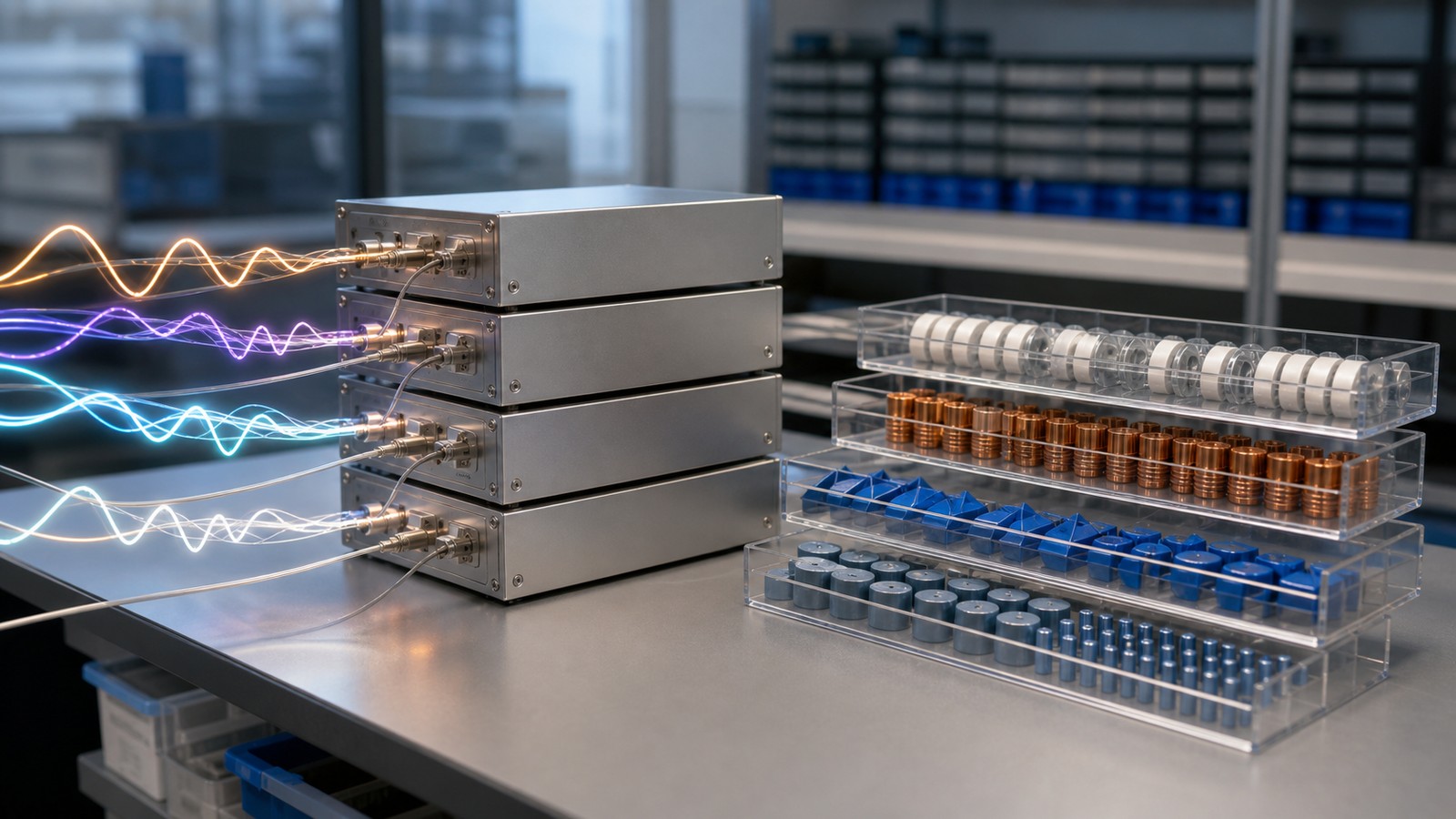
Signal Features Turn Waveforms Into Meaningful Data
Signal features are measurements that help AI systems understand raw waveforms. Instead of asking a model to interpret every point in a signal directly, engineers extract clues such as amplitude, frequency, timing, energy, shape, peaks, noise level, or rate of change. These features make patterns easier to compare across wireless, electrical, audio, sensor, and industrial systems. Good features connect the raw signal to the decision the system needs to make.
Features Summarize Signals
A feature is a useful description of a signal. It may capture how strong, fast, noisy, stable, or unusual the waveform is.
Features reduce complexity. They help models compare signals without getting lost in every raw sample.
Amplitude Shows Strength
Amplitude describes signal strength. It can reveal volume, voltage, vibration intensity, received power, or the size of a waveform change.
Amplitude should be interpreted with context. A strong signal may be useful in one system and dangerous in another.
Frequency Shows Repetition
Frequency describes how often a signal cycles. It is central to wireless channels, audio tones, vibration, alternating current, and many sensor patterns.
Frequency features can reveal interference, machine faults, speech patterns, music structure, or channel behavior.
Phase Shows Alignment
Phase describes timing alignment within repeating signals. It matters in communication, power systems, radar, and signal combination.
Small phase changes can affect performance. Engineers often use phase features when timing relationships are important.
Energy Shows Overall Activity
Energy summarizes how much activity appears in a signal over a window. It can help detect speech, events, bursts, or machine operation.
Energy is useful but broad. It may show something happened without explaining exactly what caused it.
Peaks Mark Important Moments
Peaks are high points in a signal. They can show impacts, pulses, beats, faults, transitions, or strong events.
Peak features should be robust against noise. A random spike should not be treated the same as a meaningful event.
Timing Features Reveal Order
Timing features describe when events happen, how long they last, and how much delay appears between them.
Timing matters in networks, speech, motors, medical signals, and control systems. A signal can have the right shape but arrive too late.
Rate of Change Shows Movement
Rate of change describes how quickly a signal rises, falls, or shifts. Sudden changes can reveal transitions or trouble.
Slow changes can matter too. Drift, wear, and gradual interference may appear as changing trends rather than sharp events.
Noise Features Show Quality
Noise features describe unwanted variation or uncertainty in a signal. Signal-to-noise ratio is one common example.
Quality features help models avoid overconfidence. A prediction from noisy data should be treated differently from one based on a clean signal.
Frequency Bands Add Detail
Signals can be split into frequency bands. This helps models see where energy appears in low, middle, or high frequency ranges.
Band features are useful in audio, vibration, radio, and biomedical signals. Different bands often carry different meaning.
Shape Features Capture Form
Waveform shape can reveal how a signal behaves beyond strength and frequency. Rise time, decay, symmetry, and pulse width may all matter.
Shape features are useful when two signals have similar strength but different behavior. The form can point to different causes.
Window Size Matters
Features are often calculated over time windows. The window size changes what the feature captures.
Short windows can catch quick events. Longer windows can reveal trends. The right size depends on the decision.
Normalization Improves Comparison
Normalization adjusts features so signals from different devices, sessions, or scales can be compared more fairly.
It should be done carefully. Poor normalization can remove meaningful differences or preserve misleading ones.
Feature Selection Reduces Clutter
More features are not always better. Too many weak features can make models slower, noisier, or harder to explain.
Feature selection keeps the most useful measurements. It can improve accuracy, speed, and interpretability.
Domain Knowledge Helps
Engineers often know which signal properties matter. Their knowledge can guide feature design before the model ever trains.
Combining domain knowledge with testing is powerful. The model can confirm which features actually improve performance.
What to Check Next
Teams should check whether each feature supports the real decision. A feature should have a reason to exist.
They should also test features across real devices, conditions, and edge cases. A useful feature should remain meaningful outside a clean lab setup.
Deployment Notes
Deployment should track feature definitions, window sizes, normalization methods, and model versions. Small feature changes can affect results.
Feature pipelines need monitoring. If input signals drift, features may change even when the model code stays the same.
Final Takeaway
Signal features turn waveforms into meaningful data that AI systems can compare, classify, predict, and monitor.
The best features are tied to the physical system, tested against outcomes, and maintained as conditions change.
Feature Pipelines Need Consistency
The feature pipeline used in training should match the one used in deployment. If the live system calculates features differently, model behavior can change.
Teams should version feature code and test it with known examples. This protects results from quiet pipeline drift.
Raw Signals Still Matter
Even when features are used, teams should keep access to raw signal examples for troubleshooting. Raw data helps explain why a feature changed.
Without raw examples, engineers may know that a model failed but not why the signal looked different.
Feature Importance Can Guide Review
Feature importance can show which measurements influenced a model most. This helps engineers inspect whether the model is using sensible clues.
Importance should be reviewed with domain knowledge. A model may rely on a shortcut that works in training but fails in the field.
Good Features Stay Understandable
A feature does not need to be simplistic, but it should be explainable enough for engineering review when decisions matter.
Understandable features make maintenance easier. They also help teams communicate why the system trusts a result.
Features Should Match Physics
Signal features are strongest when they reflect the physical behavior of the system. A vibration feature, wireless feature, and power feature should each describe something meaningful.
This prevents the model from relying on accidental patterns. Good features connect math with engineering reality.
Feature Windows Need Testing
The same feature can behave differently depending on window length. A short window may capture an event, while a long window may smooth it away.
Teams should test window sizes against the task. The right window is the one that preserves the pattern needed for the decision.
Feature Drift Can Break Models
Feature values can drift when sensors age, firmware changes, or the operating environment shifts. The model may still run while its inputs mean something different.
Monitoring feature distributions helps catch this drift. It can show when retraining or recalibration is needed.
Derived Features Need Documentation
Derived features may combine several measurements or calculations. They can be powerful, but they need clear definitions.
Documentation helps future teams reproduce results. It also makes debugging easier when a model changes behavior.
Features Can Hide Bad Data
A summary feature may hide missing values, clipping, or sensor faults if quality checks are not included.
Feature pipelines should include quality flags. The model should know when a feature was built from weak evidence.
Feature Sets Should Stay Lean
A lean feature set is often easier to train, deploy, and explain. Extra features can add noise and maintenance burden.
Teams should remove features that do not improve outcomes. Simpler inputs often make stronger systems.
Feature Review Needs Examples
Engineers should review features on real signal examples. Seeing the waveform and feature together helps confirm that the measurement makes sense.
Example-driven review catches strange calculations quickly. It also helps non-specialists understand what the model is using.
Final Feature Check
Before deployment, teams should confirm that features are stable, useful, documented, and calculated the same way in training and production.
After deployment, feature monitoring should continue. A feature pipeline can drift even when the model file never changes.
Feature Scaling Affects Learning
Feature scaling changes how numeric inputs compare with each other. If one feature has a much larger range, some models may give it too much influence.
Scaling should be chosen and documented carefully. The live pipeline should apply the same scaling used during training.
Outliers Need a Plan
Outlier values can represent faults, rare events, sensor errors, or important transitions. A feature pipeline should not remove them blindly.
Teams should decide which outliers are errors and which are meaningful. That decision depends on the system being measured.
Feature Correlation Can Confuse Models
Some features carry similar information. Too many correlated features can make interpretation harder and sometimes reduce model stability.
Reviewing correlation helps keep the feature set lean. It also helps engineers understand which measurements are truly adding new evidence.
Features Should Support Debugging
When a model output is questioned, features should help explain the result. Engineers should be able to see which measurements changed.
Debuggable features shorten investigation. They also make model behavior easier to discuss across teams.
Live Feature Checks Prevent Surprises
Feature values should be monitored in production. If a feature suddenly becomes constant, missing, or extreme, the model output may no longer be trustworthy.
Live checks catch pipeline and sensor problems quickly. They protect the model from quiet input failure.
Feature Engineering Is Iterative
The first feature set is rarely perfect. Teams learn which measurements matter by comparing model results with real outcomes.
Iteration should be disciplined. Each new feature should be tested for practical value, not added because it is easy to calculate.
Features Make Models More Useful
Good features give models a clearer view of the signal. They turn raw waveforms into measurements that connect with engineering questions.
That connection is the point. A feature is worthwhile when it helps the system classify, predict, detect, or explain something that matters.
Feature Names Should Be Clear
Feature names should be understandable to the people who maintain the system. A vague name makes troubleshooting harder months later.
Clear names also help during review. Engineers can discuss amplitude range, peak count, band energy, or timing delay without guessing what the pipeline means.
Features Should Be Tested Against Outcomes
A feature may look mathematically interesting and still add little value. Testing against real outcomes shows whether it improves classification, prediction, or detection.
Outcome testing keeps feature engineering practical. It prevents teams from collecting measurements that do not support the decision.
Feature Changes Need Version Control
Changing a feature definition can change model behavior even when the model file stays the same. Version control should track those definitions.
This makes future investigations easier. If performance shifts, teams can see whether the signal, feature pipeline, or model changed.
Better Features Improve Trust
When features make sense, model outputs become easier to trust. Engineers can connect the result back to visible signal behavior.
That trust matters in deployment. A model is easier to adopt when the evidence behind it is clear enough to inspect.
Useful Features Fit the Device
Features must be practical for the device or system that calculates them. A complex feature may work offline but be too slow or power-hungry for an edge device.
Deployment constraints should shape feature design. The best feature set is accurate enough, fast enough, and stable enough for the real environment.
Feature Review Should Be Routine
Feature review should happen after sensor changes, firmware updates, model updates, and unexpected performance shifts.
Routine review keeps the signal pipeline healthy. It catches problems before weak features quietly damage model output.